Independent, evidence-first advice on machine consciousness claims.
Be first to know
New papers, essays, and the book's release. A few emails a year.
Thank you! You're on the list. The next email comes when there's real news.
The book · forthcoming
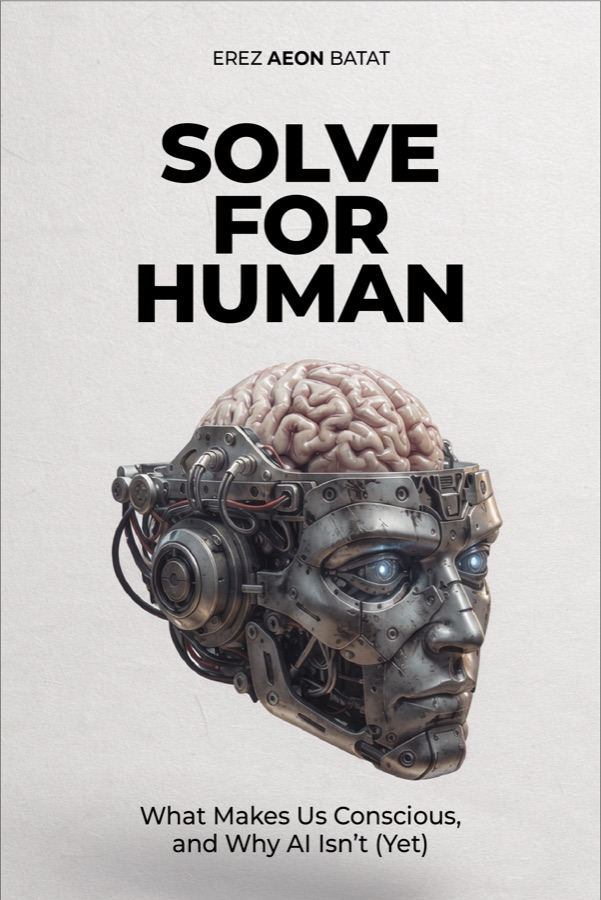
Solve for Human
What Makes Us Conscious, and Why AI Isn't (Yet)
To know whether a machine could ever be sentient, we first have to understand our own sentience. The book follows a decade of research into how the human mind produces consciousness, explains how today's chatbots actually work, and sets out a real test for each state of consciousness. Today's AI fails all three.
"From computer science to the reverse engineering of the conscious mind, this book presents a mind-blowing theory. [It] offers a unifying perspective that reshapes our understanding of the mind, thoughts, mental disorders and the future of Artificial General Intelligence. The movie I, Robot could have been inspired by it."
Lucia Adriana Lifshits, PhD · Medicinal Sciences, Tel Aviv University
Research
Evidence, preregistered.
Sealed plans, open data, open code.
PREPRINT · 2026 · UNDER JOURNAL REVIEW
Same Model, Different Wrapper
Self-reports of consciousness in two open-weights language models follow their builders' choices. A model's words cannot count as evidence of a mind, in either direction.
Qwen2.5-7BMinistral 3 8B% of 150 answers claiming inner experience
Close your eyes. Picture a ripe orange glowing in the sun.
Take a few breaths. Then open your eyes and choose what you saw.
No imageryVivid
Mind's eye
Do you see images? Aphantasia.
Inner voice
Do you hear yourself think? Anauralia.
More soon
New tests as the research grows.
About
Erez Aeon Batat
CONSCIOUSNESS RESEARCHER & AI CONSULTANT · FOUNDER, AEONGENICS · FORMER DIRECTOR OF INNOVATION, HP
I have spent my life on two kinds of architecture: software and the mind.
I started in tech at 19, earned a computer science degree in New York, and became Director of Innovation for HP's printing division. In 2012 a panic attack made me quit, and left me with a question I couldn't put down: what is the mechanism of the mind?
For the next decade I studied it the way an engineer studies unfamiliar software, by watching how it behaves. I interviewed hundreds of people about what happens inside their heads, and found that I have no mental imagery myself. That work became a new theory of consciousness, and my book.